I Noindexed 18 of My 92 Posts, and Kept Them AI-Citable
I took a fifth of RankingHacks out of Google's index on purpose: 18 of 92 posts noindexed in a week. Here's the exact decision rule I used, the full cut list, what it cost in impressions, and the one thing I did differently that most pruning guides skip: I kept every deindexed page fully citable by AI.
Last week I took a fifth of this site out of Google’s index. Eighteen posts of ninety-two, gone from the sitemap, tagged noindex, on purpose, by hand, over four days. Nobody asked me to. Traffic wasn’t collapsing. I did it because the HCU-era version of Google rewards a site that is about something and quietly penalizes one that is about everything, and after three years RankingHacks had drifted into being about everything.
This is the worked example. The exact rule I used to decide what dies, the full cut list, what it cost me in impressions, and the one move I made that most “content pruning” guides never mention: I deindexed these pages from Google without making them un-citable by AI. Those are not the same thing, and treating them as the same is how publishers throw away answer-engine visibility they didn’t need to lose.
Results aren’t the point of this post; the deindex takes weeks and I report the numbers on 2026-08-06. The point is the method, because the method is copyable and the numbers will be site-specific to me.
Why prune at all
A site is a topical signal. Every URL Google indexes is a vote for what you’re an authority on. When 40 of your 92 votes are 2023 conference recaps and one-off news posts that earn zero clicks, you’re diluting the 12 posts that actually rank. Post-HCU, that dilution is not neutral. Google’s own guidance since 2024 has leaned on site-level quality, which means the dead weight can hold down the good pages.
I’d suspected this for a while. What forced the decision was the Phase-2 measurement: of 92 posts, only about 12 earned substantive impressions in 90 days. The rest were a long tail of near-zero. That’s not a content-strategy problem you write your way out of. It’s a subtraction problem.
The decision rule (copy this)
I refused to prune on vibes. Deleting content you spent hours on is emotional, and emotion picks the wrong pages. So I wrote a rule first, ran it against 90 days of Search Console data plus 91 days of bot-filtered analytics, and let the rule decide. Every post got classified by fixed thresholds:
| Tier | Rule | Action |
|---|---|---|
| KEEP-STRATEGIC | Pillar / flagship post (a hand-picked immune list) | Never touch |
| KEEP-YOUNG | Published < 60 days ago | Protect; indexing has lag, too early to judge |
| KEEP | Earns impressions, clicks, or fits an active cluster | Leave indexed |
| NOINDEX Tier 1 | Age ≥ 180d and < 30 impressions and 0 clicks and < 10 visitors, all over 90d | Noindex now |
| NOINDEX Tier 2 (soft) | Age ≥ 180d and 30–80 impressions and 0 clicks | CTR-rewrite first; noindex only if it still fails |
Two guardrails did most of the work. The 60-day protection stops you from killing a post before Google has even finished ranking it; new content routinely sits at zero for weeks, and pruning it is self-sabotage. The Tier 2 “impressions without clicks” split is the one people get wrong: a post pulling 60 impressions and 0 clicks does not have a content problem, it has a title-tag problem. Noindexing it throws away demand you could have captured with a better headline. So Tier 2 doesn’t get deleted; it gets a rewrite pass first, and only the pages that still can’t convert get cut.
That single distinction (is this a demand problem or a packaging problem?) is the whole game. Most pruning guides collapse them and over-cut.
The cut list
Eleven posts cleared the Tier-1 bar cleanly. Every one is 240+ days old, has zero clicks, and pulls fewer than 30 impressions a quarter. Almost all are conference-recap or expert-interview posts, the kind of content that felt like authority-building in 2023 and turned into topical noise by 2026.
| Post | 90d impressions | Age (days) |
|---|---|---|
| effective-affiliate-marketing-strategies | 0 | 970 |
| insights-from-kyle-roof | 13 | 970 |
| james-norquays-expert-insights | 12 | 970 |
| jared-codling-split-testing | 4 | 970 |
| kevin-indig-ai-seo | 14 | 968 |
| john-dykstra-on-newsletters | 16 | 806 |
| doug-cunnington-on-podcasts | 6 | 805 |
| spencer-haws-amazon-influencer-program | 18 | 805 |
| googles-search-api-leak-seo-strategy | 0 | 769 |
| scientific-testing-growth-marketing | 29 | 592 |
| design-data-discovery-in-ecommerce | 6 | 241 |
Then seven of the fifteen Tier-2 posts, the ones that flunked the rewrite test up front because they were both old (≥180 days) and ranking too deep for a headline to save them. The other eight Tier-2 posts are still indexed, getting their title-and-description rewrite pass; I decide their fate on 2026-08-06 based on whether the rewrite earned a single click.
Total shipped: 18 posts, ~20% of the corpus. With the eight Tier-2 survivors likely to follow, the plan lands near 28%, the “aggressive” target I set going in.
What it cost, and why the math is the good news
Here’s the number that makes pruning easy to justify to yourself. Those 18 posts, combined, accounted for roughly 1.7% of my 90-day impressions. So the trade is:
- Give up: ~1.7% of impressions (all of it at zero clicks anyway)
- Get back: a 20% smaller, denser corpus where the remaining pages carry the topical signal
You are not sacrificing traffic. You are removing pages that were already earning nothing and asking Google to re-weight the signal toward the pages that earn something. The impressions you delete are impressions that never converted and never would.
The honest caveat: I can’t show you the “after” yet. Deindexing lags. When I sampled six pruned URLs in Search Console, only three were still actively indexed and awaiting recrawl; the rest had already fallen out of Google on their own. The corpus-size and position numbers move over the following one to four weeks. I recorded a full baseline the day I submitted the new sitemap so the Day-66 checkpoint is a clean before/after rather than a guess. That’s the discipline this kind of change demands: measure the baseline before you can see the result, or you’ll rationalize whatever happens.
The part nobody does: deindexed ≠ un-citable
This is where I broke from the standard pruning playbook, and it’s the reason this post exists.
When most people prune, they 410-delete the page or slap a noindex on it and consider it erased. But “erased from Google” and “erased from the web” are different erasures, and in 2026 that difference is money. AI answer engines (ChatGPT, Perplexity, Google’s own AI surfaces) don’t read your content exclusively through the Google index. They fetch your llms.txt, they read structured-data endpoints, they crawl plain-text alternates. A page can be worthless in a Google SERP and still be a perfectly good source for an AI answer.
So I used noindex, follow, not deletion, and I deliberately left every AI-facing surface intact: the pages still resolve 200, still carry their machine-readable schema, still appear in the site’s llms.txt and its .md alternates. Google is told “don’t rank this.” The answer engines are told nothing; they can still fetch, read, and cite it.
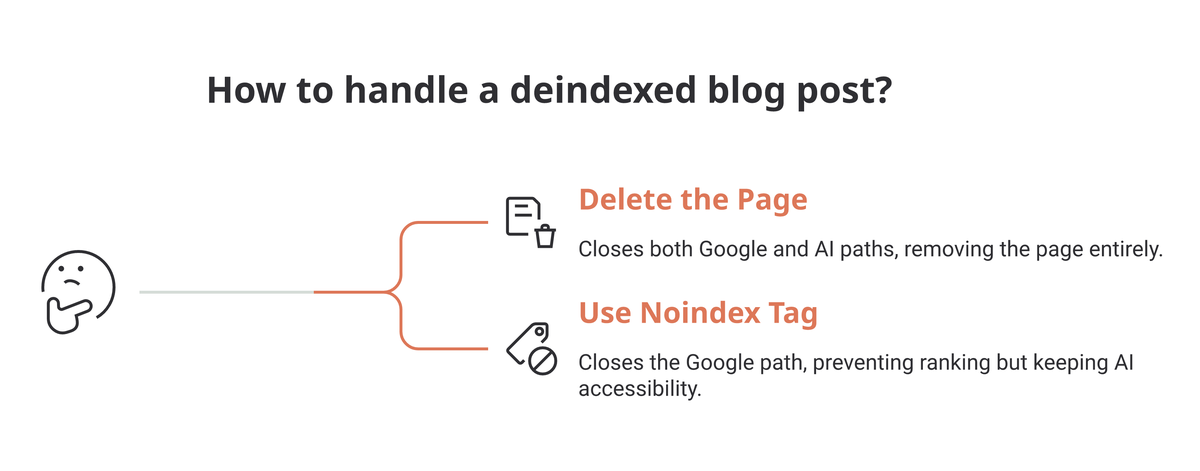
200 with its llms.txt entry, schema, and .md alternate intact, so ChatGPT and Perplexity can still cite it. Same removal from search, very different outcome for AI visibility.This is the whole RankingHacks thesis in one operation. Google visibility and AI citability are separate distribution channels now. A 2023 interview post that Google should stop ranking might still be a useful primary source when someone asks an AI “what did Kyle Roof say about on-page testing.” Deleting it forecloses that. Noindexing it keeps the option open at zero cost. If you’re pruning for Google and taking your pages fully offline in the process, you’re optimizing for one channel and vandalizing another.
The mistake I made (so you don’t)
The automated audit that generated my cut list tried to hand me a “consolidate these two duplicate posts” recommendation. One of the two slugs it named didn’t exist; it was a from-memory paraphrase of a real post’s title that the audit had hard-coded, which then made the real post look like a duplicate of a phantom. I caught it because I verify every slug resolves 200 before acting on it. If I hadn’t, I’d have 301-redirected a nine-day-old flagship post into a page that returns 404.
The lesson generalizes past pruning: never act on a URL you generated from memory. Enumerate your actual files, confirm each one resolves, then decide. This is the same rule that keeps you from shipping broken internal links, and it’s the difference between an audit that improves your site and one that quietly breaks it.
If you want to copy this
- Pull 90 days of Search Console + analytics per URL. You need real signal, not gut feel.
- Write the thresholds before you look at the list. Fixed rules pick better than in-the-moment emotion.
- Protect anything under 60 days old. Ranking has lag; don’t kill a post mid-climb.
- Split “no demand” from “bad packaging.” Impressions with zero clicks = rewrite the title first, prune only if it still fails.
- Use
noindex, follow, keep the page live, keep the AI surfaces intact. Deindex from Google without deleting yourself from the answer engines. - Verify every slug resolves before you touch it. Audits hallucinate URLs; you shouldn’t act on them blind.
- Baseline before you can see the result. The deindex takes weeks; record the starting numbers or you’ll never have an honest before/after.
I’ll post the actual position and click movement on 2026-08-06, when Google has finished recrawling. If pruning a fifth of a site does what the HCU-era guidance implies it should, the remaining pages get denser topical authority and the numbers on the 12 posts that matter improve. If it doesn’t, I’ll say so here. That’s the deal with running these experiments in public.
Related reading on the two-channel thesis: my GEO self-audit, what happened when I GEO-optimized my own site, and how I actually track AI citations.